|
Each week our specialists publish a research paper about Art and its markets.
Antiques, painting, drawing, sculpture, furniture, fine art, porcelain, ceramic, work of art, carpet, tapestry, silver are among the subject studied.
You can receive our free weekly research paper by email by subscribing to our newsletter.
 On October 31 at Le Raincy (near Paris), Touati-Duffaud auctioneer, assisted by our specialists, will auction a rare set of tapestries of the seventeenth and eighteenth centuries, one of Brussels and two woven in Aubusson. One of these tapestries covers a highly symbolic theme since the late Middle Ages: the bear hunting.
For years the king of the animals was not the lion. Since prehistoric times, this is the bear which was the subject of all admiration. In the middle Ages, however, the beast is humiliated and hunted.
In Europe, the bear hunt was long encouraged by the Church who saw the brown bear as a rival of Christ. In France, the last official track took place in 1963.
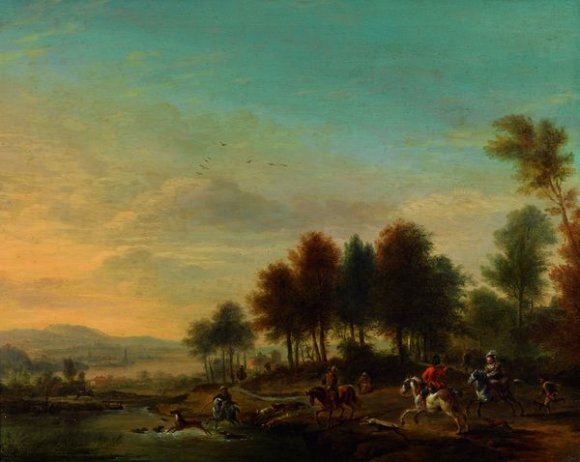
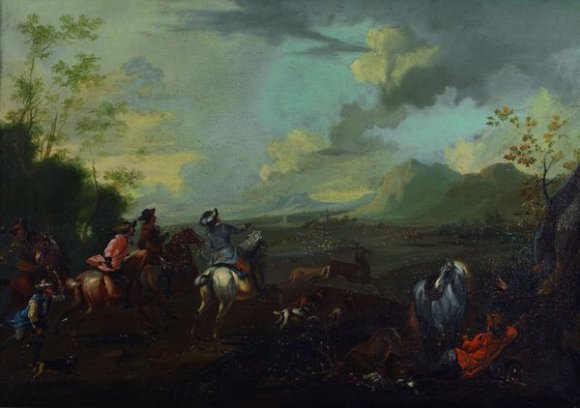
This hunt was the subject of many representations.
This is precisely one of the main themes of the tapestry, woven in Aubusson in the seventeenth century, which will be offered for sale in late October.

Measuring 2m90 high by 2m27 wide and in good condition, it is reasonably estimated at between £1,000 and £1,500.
If you like the subject and that you have the required height under ceiling, this tapestry could be proven to be a very good investment for two reasons: » More

 On October 11 in Saint-Cloud, Le Floc'h auctioneer assisted by our experts in furniture and fine art will auction drawings, paintings, antique furniture and objects d'art. » More

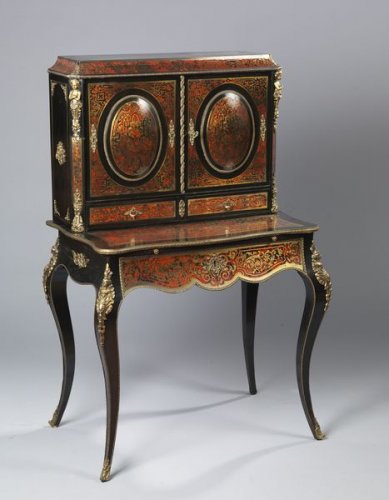
 Having a secretary does not seem given to everyone. It is however now possible to get one for less than £1,000, and for an indefinite term...
It was at the time of Louis the 14th that the secretaire is born. This is the Age of Enlightenment that it reached its peak. "brisé", "slope", "cylinder", "drawer" shape fits all purposes. Its great advantage over the desk is that it locks. It allows keeping its precious documents safe from prying eyes.

Of all the secretaries, the most famous is called "à abattant". It is the one that will be the most products until today. Its top panel falls horizontally to serve as a writing desk and give access to numerous drawers or lockers. Warning! This piece of furniture often has a bonus drawer, a "secret" as they say. This is where the "old" hid their gold. Own one, may well reveal some great surprises!
Like many antique furniture, secretaires do fall out of favor, except to when they are exceptional. It is indeed very unfair as the furniture is very functional and often small dimensions. » More


Jewelry, modern paintings, signed ceramics, antique furniture ... this week we offer you a small selection of works auctioned in recent months by our firm. Reasonable estimates in the art market with changing moods allowed these works to sell all above their high estimate and in some cases a surprise. Review.
Jewelry
Lalique, best known for its works in glass and crystal vases and especially the famous and popular car mascots was also a great jewelry designer. The lorgnette sold by SVV Aguttes with our collaboration is a perfect example. Executed in 18 K yellow gold, it has a horn carved decor accented with purple enamel and two amethysts. It is characteristic of the Art Nouveau era, the most sought time for jewelry collectors of Lalique. Conservatively estimated between 4,500 Euros and 6,500 Euros, he found a buyer at 45,900 Euros inclusive buyer premium.
Modern painting
Eugène de Kermadec (1899-1976) was a French abstract artist who made out the Cubist movement in 1918. "La Navigation”, an oil on canvas signed and dated 1947, was sold at auction by Aguttes auction house with the collaboration of our consultants firm. Measuring 60cm high by 81 cm wide, it came from the Simon Gallery according to a label on the back. Estimated between 3,000 and 4,000 Euros, our painting was sold with the buyer premium for 8,798 Euros. That bid confirms the appetite of collectors for great abstract painters whose prices remains affordable. (Main picture)
Ceramics
From ceramics, emphasize two vases, sold by SVV Aguttes and the specialists of Authenticité, signed Josep Llorens Artigas (1892-1980) in brown glazed ceramic for the first one and a nuanced white for the second (shown) signed and dated respectively 1950 for the first and 1937 for the second. Estimated EUR 1 500 to 2 000 for the first, it sold in the estimate to 2,168 Euros premium included when the second estimated 1,200/1,500 Euros was sold for 2,423 Euros with premium despite some accidents reported in catalog. For the record, these two vases had been offered by the artist to the family of the seller.
Furniture
» More

 Do you see geometric shapes moving? Are you dizzy? Don’t worry; you simply look at a work by Vasarely, founder of the optical Art, major artist of the 20th century. Back to the secrets of this magician of abstraction and its place in the art market.
Victor Vasarely was born in Hungary in 1906. He arrived in Paris in 1931, already aware to abstraction and technical progress. His artistic research led him to become interested in the movement, with artists such as Alexander Calder, Julio Le Parc, Soto or Tinguely. These so-called kinetic artists seek to create the illusion of motion in a stationary work. The kinetic art then intersects many different practices, both motorized works as works altered by the intervention of the wind or water.

Vasarely develops in the 1950s a geometric abstract art based on visual ambiguity. In this optical art, or Op' art, the viewer is the engine of the work. The reliability of our vision is challenged through optical illusions. Vasarely uses uniform color units that will be repeated align to form geometric shapes that can be manipulated. It then emerges from the work a vibrating sensation, an illusion of relief or depth disorienting the viewer.

Vasarely died in 1997 and is successful in his lifetime. And for fifteen years, the psychedelic 1960s, playful and decorative, knows a renewed interest.
Defender of a democratic and accessible art, Vasarely favored multiple such as screen printing and lithography. There are now in abundance on the market at reasonable prices. Authentic print is trading between £200 and £800. Original works, such as drawings or paintings, less frequent, are negotiated between £2,000 and £8,000 for the former and up to £200,000 for the latter. Finally Vasarely experimented with various materials, collage, ceramics and tapestry works sought demanding collectors.
The art of Vasarely is a breakthrough and a fundamental art movement in the birth of contemporary art. The extent and variety of its production today can meet the wishful thinking of the artist; make it accessible to the greatest number.
Anaïs Couteau
Publish in collaboration with » More


 Chest, document holder, cabinet of curiosity, writing desk, the Bargueno was THE furniture all in one to own in Spain during the Renaissance. But no need to be conquistador or missionary to enjoy this highly decorative piece of furniture that now operates a noticed return.
Spain, 16th century. The empire was at its peak, the Muslims were defeated and Spain is sovereign in its territory. A piece of furniture will become characteristic of the Spanish Prosperity: Bargueño. It will emerge as the preferred piece of furniture of the nobility and the burgeoning bourgeoisie. Portable and secure it was used for storing in a beautiful green wood, archives, curiosity or liturgical object

From the outside, the Bargueño is an entire impregnable fortress. It comes in the form of a chest of solid wood fitted with handles and placed on independent feet or a table. The exterior decoration is typical: perforated iron plates on red velvet background adorn the locks and handles. Open the piece of furniture reveals a harmonious composition of small drawers, doors and secret compartments. The interior of a Bargueño is a masterpiece using materials like ivory, gold metal or carved wood...

The decoration of a Bargueño is sometimes influenced by Islamic art and the style Mudejar . The Bargueño is then decorated with geometric compositions made with small pieces of wood, ivory, mother of pearl or bone.
The Bargueño fell into obscurity in the 18th and 19th centuries. It is now once again become popular. Prices start around £1000 for a simple and late Bargueño. For £4 to £6,000, it is perfectly possible to acquire a more refined Bargueño which will have preserved its delicate decorations. More rarely, a complex Bargueño with its original decor can exceed £15 to £20,000. » More

 The Orient is undoubtedly one of the subjects attracted painters from the late eighteenth with artists such as Liotard. But it was with the conquest of Algeria that many artists painted North Africa until the mid twentieth century. Those are the Orientalist painters.
Popular with artists, Orientalism has been since its beginnings among collectors and Orientalist paintings are still highly successful in auctions.
Alongside the big names such as Delacroix, Fromentin, Dinet, Majorelle or Washington for which market quotations exceed the tens of thousands, there are many lesser-known artists of great talent that can be afford between £1,000 and £10,000.
The sale of Philocale auctioneer on April 11 offered a wide range; let's look at three of them, Victor Huguet, Alexis Auguste Delahogue and Paul Leroy.
Victor Huguet (1835-1902)
Student of one of the great masters of the Orientalist Eugène Fromentin, he made a first visit to Egypt at the age of 17. » More

 It's small, sometimes funny, scary or touching, it is collected and there are thousands of different. No, this is not the latest trendy toy for your children, but the netsuke, a small 100 years old Japanese sculpture with charm, popular in the auction house.
The traditional Japanese dress, the kimono has no pockets. To carry the common objects of everyday life, men used small bags or boxes attached to the belt by a cord. To block this string an object generalizes from the 17th century, the netsuke. The most popular form of this netsuke is a small sculpture carved on all sides, with two holes for passing the string.

The netsuke, of wood, ivory or porcelain, ceramic or shell, is going to become a preferred medium of the imaginary of Japanese artists. Deities, naturalistic or fantastic bestiary, expressive characters of everyday life or the theater, the topics are endless and will reflect the richness of Japanese culture.
In the 19th century, during the Meiji era, the kimono is abandoned in favor of a more European fashion. The netsuke loses its utilitarian function to become purely decorative. The Empire of the Rising Sun opens to the West. Paris is fascinated, and is enthusiastic about this exotic culture and particularly these mini-sculptures character. Some as the Goncourt brothers begin collections. The Japanese netsuke production will further turn to export.

The many netsukes exposed nowadays auction houses are inherited from this taste for Japanese culture that was born in the late 19th century. All are not equal and it is important to ensure the authenticity of the object. The quality of the sculpture, condition and the subject can vary the price from £100 to more than £6,000. In 2005, a netsuke representing Shoki the giant fighting against demons was sold for over £100,000!
Anaïs Couteau
In collaboration with » More

 Saturday, April 11, Philocale auction house sold a collection of modern paintings and furniture and objets d'art with the collaboration of our specialists. The star of the day was undoubtedly the lot 147, an oil on canvas by Toshimitsu Imaï, sold for 81,000 Euros, hammer price.
Lot 147
Entitled "Soleil noir", our painting is signed and located in Paris. It was purchased by the seller to the Argos gallery in the 60s and measures 130 cm by 161 cm. Despite an accident and some uprisings, fans around the world were present whether by phone or internet for bidding. Estimated between 8,000 and 12,000 EUR, bid strated at 10,000 Euros with a tough battle up to 36 000. From there, two telephones came into competition with a final bid of 81,000 Euros, the world record for the Japanese artist Toshimitsu Imaï.
Toshimitsu Imaï
» More
|